

Thiksey Monastery (Thikse Gompa) Ladakh, India. "Perched between earth and sky, where every sunrise feels like a blessing"
2026-03-09_Leh_Ladakh_IND-222

Maitreya Buddha Temple (Chamchung) in Leh, Ladakh, India.
"Mallard ducks glide serenely on a winter canal as the golden Maitreya Buddha watches over Leh — where the Himalayas meet ancient Tibetan Buddhist heritage in the high-altitude desert of Ladakh."
2026-03-07_Leh_Ladakh_IND-226

"Twin Flames" Petronas Twin Towers, Kuala Lumpur, W Malaysia. "The Petronas Twin Towers pierce a brooding night sky above Kuala Lumpur, their steel-and-glass spires blazing against storm-laden clouds. Icons of a nation's ambition, standing luminous and unyielding in the heart of Malaysia's capital"
2020-02-23_Petronas Twin Towers_KUL_MYS-7

"Centuries Apart" Qutb Minar, New Delhi, India.
"A modern jetliner glides silently over the summit of the Qutb Minar, Delhi's 12th-century sandstone minaret — two monuments to human ambition, separated by 800 years, sharing the same sky for a fleeting moment"
2024-03-17_Delhi_IDN-198

"Gateway to Eternity" Qutb Minar complex, New Delhi, India.
"The setting sun blazes through the ruined arches of the Quwwat-ul-Islam mosque at the Qutb Minar complex, Delhi — India's oldest surviving mosque, built in 1193 CE from the stones of 27 demolished Hindu and Jain temples. Pilgrims and tourists move beneath archways that have framed eight centuries of sunsets, as the 7-metre iron pillar of Chandragupta II — forged around 375 CE and rust-free to this day — stands sentinel in the gathering dusk"
"The setting sun crowns a crumbling archway, casting a starburst of light through centuries-old sandstone as visitors wander the ancient courtyard. A fleeting alignment of sun, stone, and time — where the medieval world and the modern meet in long, quiet shadows"
2024-03-17_Delhi_IDN-298

2024-03-17_Delhi_IDN-163

"Stillness Within the Arch" Jama Masjid, Old Delhi, India.
"Inside the great liwan of Jama Masjid, Old Delhi, two worshippers inhabit the same sacred space in entirely different ways — one seated in quiet contemplation before the mihrab, another moving through the colonnade's filtered light. Built in red sandstone and white marble by the Mughal Emperor Shah Jahan and completed in 1656, this is one of Islam's grandest congregational mosques, a place where the geometry of empire and the intimacy of private prayer have coexisted for nearly four centuries. The arched frame within a frame draws the eye deep into the prayer hall, collapsing the distance between architecture and devotion"
2024-03-17_Delhi_IDN-71

"The Golden Court of Amer" Jaipur, Rajasthan, India.
"The great forecourt of Amber Fort spreads wide beneath the Aravalli hills, its pale sandstone ramparts glowing against the green ridgeline where the walls of Jaigarh Fort trace the high ground above. Built by the Kachhawa Rajput rulers from the late 16th century onward, Amber was both a military stronghold and a seat of refined courtly power — its architecture a synthesis of Rajput and Mughal sensibilities that would influence palaces across northern India. Visitors crossing Jaleb Chowk today walk the same stones as war elephants and imperial emissaries once did, the scale of the space still speaking of a sovereignty that answered to no small ambitions"
2024-03-16_Delhi_IDN-129
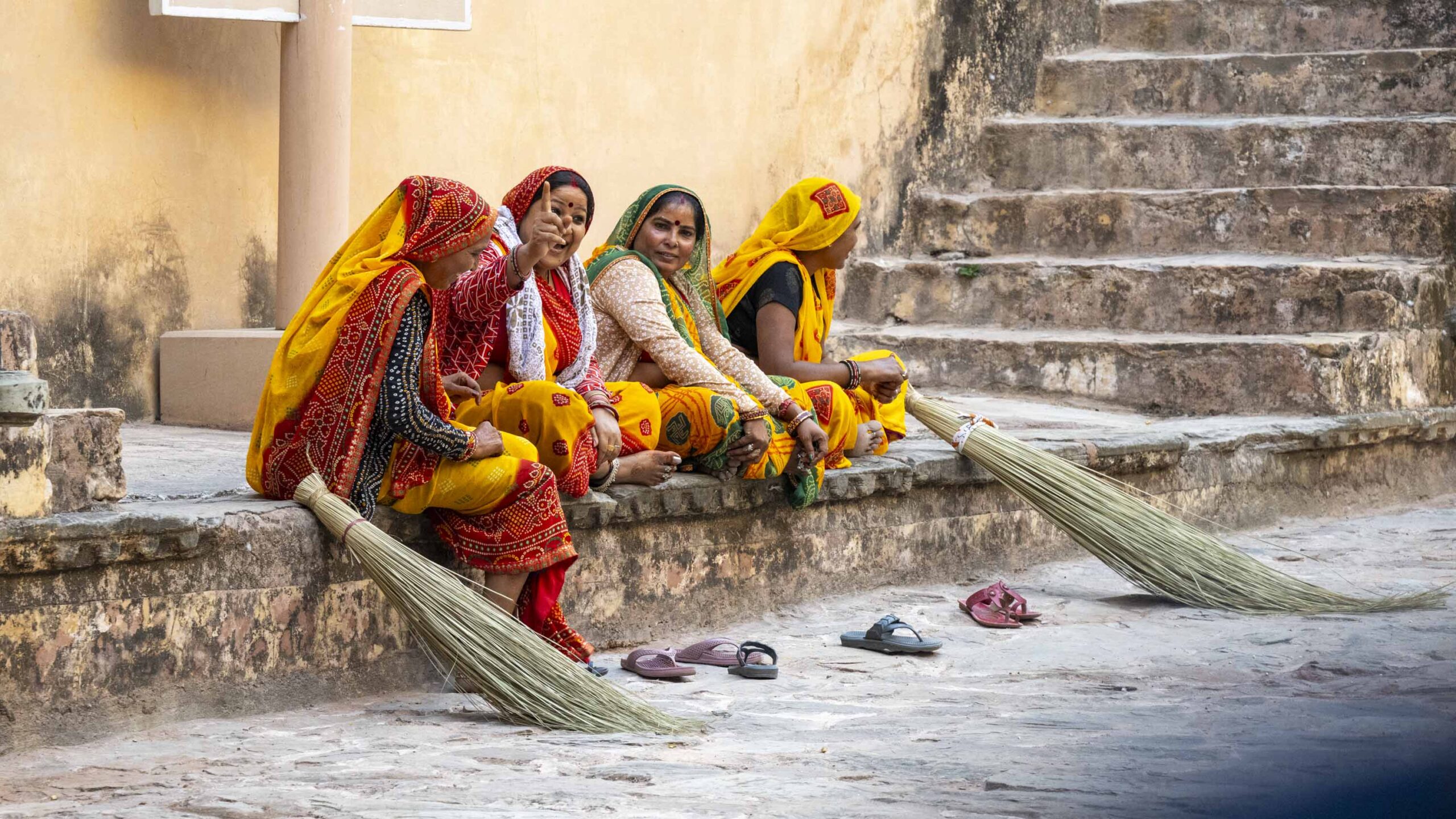
"Between Sweeps" Amber Fort, Jaipur, Rajasthan, India.
"In the shadow of Amber Fort's ochre walls, these women sweepers (safai karamcharis) with their brooms across their laps — a moment stolen between the endless work of keeping a 16th-century sandstone citadel clean for the thousands who pass through it daily. Their saris burn against the pale stone in saffron, crimson, and gold, a colour palette as old as Rajasthan itself. They are not tourists, not performers — they are the unseen architecture of the place, as much a part of its daily life as the ramparts and the carved jharokhas above them. The discarded sandals say everything about how long they have been sitting, and how comfortable they are doing so"
2024-03-16_Delhi_IDN-86

"The Palace the Lake Keeps" Jal Mahal, Jaipur, Rajasthan, India.
"Jal Mahal rises from the still waters of Man Sagar Lake as if the Aravalli hills simply decided one day to build a palace and let the water decide how much of it to reveal. Four of its five storeys lie submerged beneath the surface; what the eye sees is only the crown — chhatri pavilions, rooftop trees rooted in centuries of accumulated silence, and red sandstone slowly being returned to its surroundings. Built in the 18th century for the Maharajas of Jaipur as a duck-hunting lodge and royal retreat, it has long since outgrown that modest brief, becoming one of Rajasthan's most quietly haunting landmarks — a palace that belongs more to its reflection than to any court"
_DSC9066